
Tallahatchie County Release Date Meaning
Mississippi Department of Corrections uses the exact label Tentative Release Date on its public inmate profile. “Projected release date” is common search language, but the state label matters. The figure is a calculation from information then in the record. It is not a release order, a promise of pickup on that day, or proof that the person left custody. MDOC also calculates parole, earned-release supervision, tentative discharge, and maximum dates. Each answers a different question.
A pretrial detainee does not have a sentence-based release date. Bond, dismissal, a court order, or another hold can change the outcome. A sentenced person may have a computed date, but the actual event can be parole, ERS, discharge, or transfer. Parole is a discretionary release granted by the Mississippi State Parole Board. ERS is conditional release under MDOC jurisdiction. Full discharge ends the sentence or supervision term.
Find Tallahatchie County Release Dates
Start with custody provenance, meaning the agency with legal control. A person physically held at Tallahatchie County Correctional Facility may belong to Tallahatchie County, another county, MDOC, USMS, ICE, or an outside state. The sending authority’s record controls the calculation. For an MDOC prisoner, use the state search. For a local sentence, ask the sentencing clerk and jail records custodian. Do not apply a state-prison formula just because the person is confined in Tallahatchie County.
- Collect the full name, date of birth, case number, booking or agency number, and suspected custodian.
- For MDOC custody, open the MDOC inmate search and search by first name, last name, or MDOC number.
- Open the detail and verify date of birth, MDOC number, conviction county, sentence, and current location.
- Record the exact Tentative Release Date and the day the profile was checked.
- Request the current time sheet through the case manager or MDOC Records when the computation must be explained.
- For a county sentence, obtain the judgment, commitment, jail-credit calculation, release order, and actual release entry from the proper offices.
- Confirm whether the event will be parole, ERS, discharge, or transfer.
A broader custody and release-record workflow appears on the Tallahatchie County released inmates home page. It helps when a name vanishes from one roster or when the contract facility points to a different sending jurisdiction.
The MDOC search form shows the name and MDOC-number inputs used to locate a state prisoner.
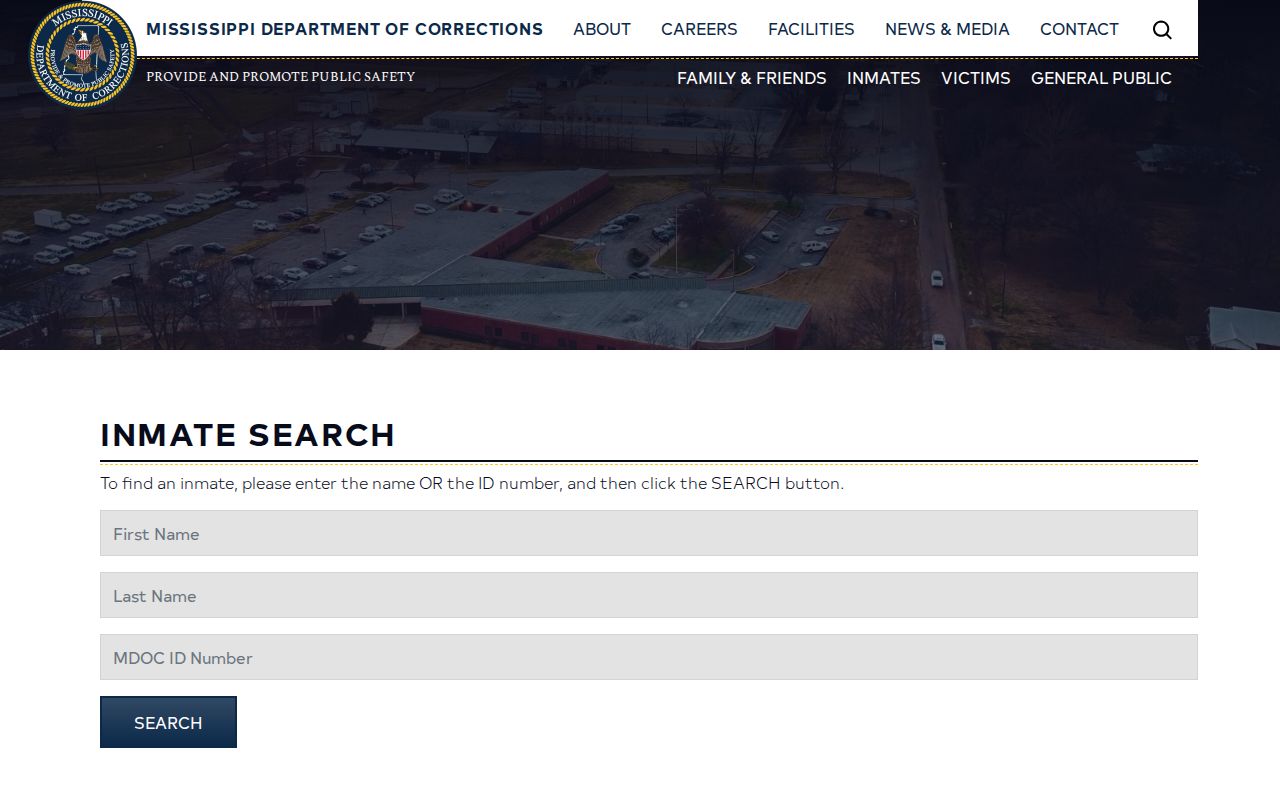
After opening a match, compare its identifiers before relying on the Tallahatchie County release-date field.
Tallahatchie County Time Calculations
The sentence begins with the judgment and qualifying credit. MDOC’s handbook says eligible presentence county-jail credit must relate to the cause number for the current incarceration. MDOC obtains or requests that credit from the county of conviction. If credit is missing, disputed, or later corrected, the Tentative Release Date can move. Consecutive sentences run one after another, while concurrent sentences overlap. That structure can change the calculation far more than a simple percentage.
Miss. Code §47-5-138 permits, for many covered sentences imposed after June 30, 1995, 4.5 days of earned time for each 30 days served when MDOC finds that conduct and performance standards are met. The reduction is generally capped at 15 percent, subject to conditions and exceptions. This produces the familiar shorthand that a covered person serves about 85 percent before the earned-release portion.
That shorthand is not a universal rule. Offense date, offense type, mandatory minimums, habitual status, life sentences, sex offenses, specified violent offenses, loss of earned time, and other exclusions can alter or bar the reduction. Section 47-5-139 lists major exclusions. Parole eligibility under §47-7-3 follows a separate framework and cannot be reached by merely subtracting 15 percent from the sentence.
ERS also explains why “released” and “inmate status” can appear together. A person released under the earned-release provision remains under MDOC jurisdiction until sentence expiration. The individual has left secure confinement but has not reached full discharge. The supervision record and later flat-time date help mark the steps. A Tallahatchie County projected release search should name the stage rather than treating all dates as the same endpoint.
- Jail credit
- Qualifying time served before the state sentence begins, tied to the correct cause number.
- Earned time
- A conditional sentence reduction calculated under applicable law and MDOC rules.
- Flat-time date
- The sentence-expiration date before a qualifying early-release mechanism is applied.
- Time sheet
- The detailed MDOC computation record behind the public tentative field.
Tallahatchie County Release Date Changes
The public date can change when the information behind it changes. A later judgment, corrected credit, a new sentence, discipline, escape, revocation, or release-plan decision may alter the calculation. A detainer is a request or legal basis for another agency to take custody. It may prevent community release even if the present sentence reaches its end. The date alone does not reveal that next step.
| Factor | Possible effect on the date or event |
|---|---|
| County-jail credit correction | Changes the sentence begin date and the time left to serve. |
| Concurrent or consecutive structure | Changes whether sentences overlap or run one after another. |
| Earned-time gain or forfeiture | May shorten or lengthen the estimate for an eligible sentence. |
| New judgment or revocation | Can add time or replace the calculation now shown. |
| Detainer or hold | May cause a transfer to another custodian instead of community release. |
| Parole decision | A grant can permit conditional release; eligibility alone does not. |
| Release-plan processing | Can delay an expected event while required steps remain incomplete. |
For a Tallahatchie County sentence, no official county-specific good-time or weekend-release rule was located. Ask the sentencing clerk and the actual jail custodian for the governing credit method. MDOC’s state-prison formula should be used only when MDOC controls the sentence, even if the person is housed in a county-named building or work program.
A county court order and the jail record serve different roles. The order states what the court authorized. The release log shows when the custodian acted and whether another agency received the person. Compare both records when a date passed without a clear community release. A second case, detainer, or transfer may explain why the expected outcome changed.
Tallahatchie County MDOC Release Timing
MDOC distinguishes ERS, a tentative date, a maximum date, and actual discharge. Its official guidance says parole and ERS dates are not guaranteed. Release processing can take 30 to 45 days, the case manager provides the actual release information, and a discharge certificate is required before release. The date shown on a profile is therefore not a same-day pickup promise.
This distinction is acute when someone transfers from Tallahatchie County or Tallahatchie County Correctional Facility into MDOC. The local event may be a transfer or commitment. Once MDOC takes legal custody, a new verification chain begins: active inmate profile, time sheet, case manager, release mode, facility event, and any later supervision record. The local exit timestamp cannot stand in for the MDOC discharge.
The MDOC release-processing guidance documents the role of the case manager and discharge certificate.

The official guidance explains why a Tallahatchie County tentative release date must be checked against completion of the actual MDOC release process.
Note: Record the date of every profile check because a later Tallahatchie County release-date result may reflect new credit, orders, discipline, or processing.
Tallahatchie County Release Status Labels
A location or unit label is not a release status. MDOC records may name a county facility or community work program while the person remains in MDOC custody. ERS creates another careful distinction: the person may live outside secure confinement while keeping inmate status and remaining under MDOC jurisdiction until sentence expiration. Physical release, supervision, and final discharge are three separate stages.
The separate MDOC Parolees Search can support a finding that prison custody changed to parole. Its record may show the MDOC ID, date of birth, supervision county, officer, and flat-time date. The county in that record is the supervision county, not proof of the arrest site, conviction county, or place of release. No parolee result may mean discharge, probation, a spelling issue, another system, or no public match. It must not be read as proof of a specific outcome.
The same caution applies to Tallahatchie County Correctional Facility. Its county name describes a place, while current operator materials identify contract populations tied to other authorities. A location match can help find the person, but the sending jurisdiction sets the sentence record and controls the release. Ask the facility to identify that custodian before choosing a state or federal date source.
| Label | What it means |
|---|---|
| Facility or unit | A reported placement within a custody system. |
| Parole | Conditional community supervision after a Board grant. |
| ERS | Conditional release with continued MDOC jurisdiction and inmate status. |
| Transfer | Custody continues under another place or authority. |
| Discharge | The sentence or supervision term has ended. |
Confirm Tallahatchie County Release Dates
Capture the public Tentative Release Date and the profile-check date. Next, obtain the current time sheet or ask the case manager to explain the computation. Verify the intended release mode. Then confirm the facility’s actual release date and time, destination, and receiving agency. A discharge certificate or release entry is stronger proof than an expired estimate. If parole follows, compare the Parolees Search and the Tallahatchie Probation & Parole Office assignment.
MDOC Records can be contacted at P.O. Box 24388, Jackson, MS 39225, by phone at 601-933-2889, or by email at MDOCRecordsDepartment@mdoc.state.ms.us. A formal public-records request must follow MDOC’s written route. Identify the person with an MDOC number and date of birth when available, and ask for existing nonexempt records rather than a new calculation.
For a local Tallahatchie County sentence, request the judgment, credit calculation, release order, and booking or release log. Court action may authorize release, but the custodian must confirm it was carried out and no other hold remained. A VINE alert can flag the event when the agency participates, but it does not replace the final agency record.
Notification can be useful near an expected date. Register only after matching the right person and agency, then read any transfer or release alert with care. The Tallahatchie County VINELink check explains local participation limits, registration continuity, and direct confirmation. Save the alert with the profile snapshot and final record so the sequence is clear.