
Tallahatchie Parole and Probation Differences
Mississippi uses several labels for community supervision, and each label points to a different legal status. Parole is a conditional release from a prison sentence approved by the Mississippi State Parole Board. Probation is ordered by a court and can be an alternative to incarceration. Earned-release supervision, often shortened to ERS, allows a qualifying person outside secure confinement while inmate status and Mississippi Department of Corrections jurisdiction continue until sentence expiration. Complete discharge is different from all three because the sentence and supervision term have ended.
The distinction matters in Tallahatchie County. The public MDOC Parolees Search can confirm a live parole record, but the research found no equally advertised public probation search. A parole record may list Tallahatchie as the supervision county even when the arrest or conviction happened elsewhere. A court docket may show probation, yet the Tallahatchie Probation & Parole Office is the right place to confirm whether that office handles reporting.
The Tallahatchie County Correctional Facility is a multi-client contract prison, so departure from that physical site does not establish parole or probation. The person may return to a sending jurisdiction or move to another custodian. Identify the legal custodian before using a Mississippi supervision search.
| Status | Who orders it | Best public verification | What it means |
|---|---|---|---|
| Parole | Mississippi State Parole Board | MDOC Parolees Search, then the supervising office | Conditional release from a prison sentence |
| Probation | Sentencing court | Court docket and local MDOC office | Court-ordered supervision, sometimes without prison |
| ERS | State law and MDOC computation | MDOC record and office confirmation | Conditional release with inmate status continuing |
| Discharge | Sentence and supervision completion | MDOC discharge record or court record | State correctional supervision has ended |
Verify Tallahatchie Post-Release Supervision
Begin with enough identifiers to distinguish people who share a name. The MDOC parolee detail may show a photograph area, MDOC ID, date of birth, supervision county, supervising officer, and flat-time date. The county field means the place of supervision, not necessarily the place of conviction. If the issue is probation, ERS, intensive supervision, or office assignment, the local MDOC office or sentencing court must fill the gap left by the public parole search.
- Open the MDOC Parolees Search and search the exact name. Compare the MDOC number and date of birth when available.
- Read the status and supervision county carefully. A current parole match supports parole supervision, but it does not prove where the person was arrested or convicted.
- For probation or ERS, check the sentencing court order and call the Tallahatchie office. Ask whether it is the assigned reporting office and what public status it can confirm.
- If the person is absent, contact MDOC Records. Do not infer discharge, a warrant, or absconding from a blank result.
- For a parole decision or hearing status, contact the Parole Board rather than the field office. Confirm physical release separately because a grant can precede actual release.
The official MDOC parolee search shows the separate public route used after a prison release to parole.
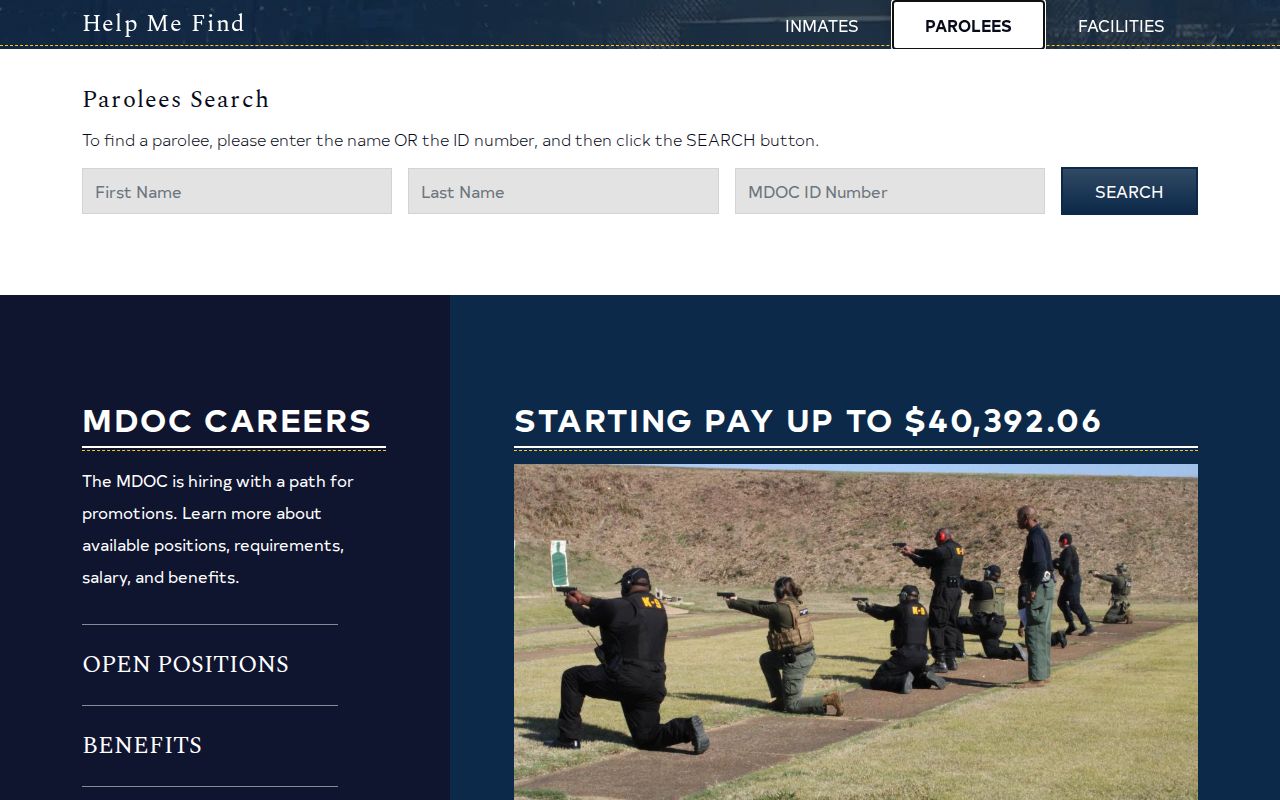
The screen helps identify the right system, while the underlying MDOC record and local office remain the stronger sources for disputed or incomplete supervision details.
Important: A current jail roster tracks custody, not post-release supervision. A released person may instead appear in the parolee system or a court record.
Tallahatchie Supervision Office Details
The Tallahatchie Probation & Parole Office provides a concrete local route for questions about reporting-office assignment. It is an MDOC community corrections office. It is not the county jail, the Parole Board, or proof of a local bond release. No public office hours were stated in the captured source, so callers should confirm availability before visiting.
Tallahatchie Probation & Parole Office
146 North Panola Street
Charleston, MS 38921
Phone: 662-647-8750
Fax: 662-647-8756
Hours: Call to confirm
The official office listing identifies the Charleston location and its direct telephone route.
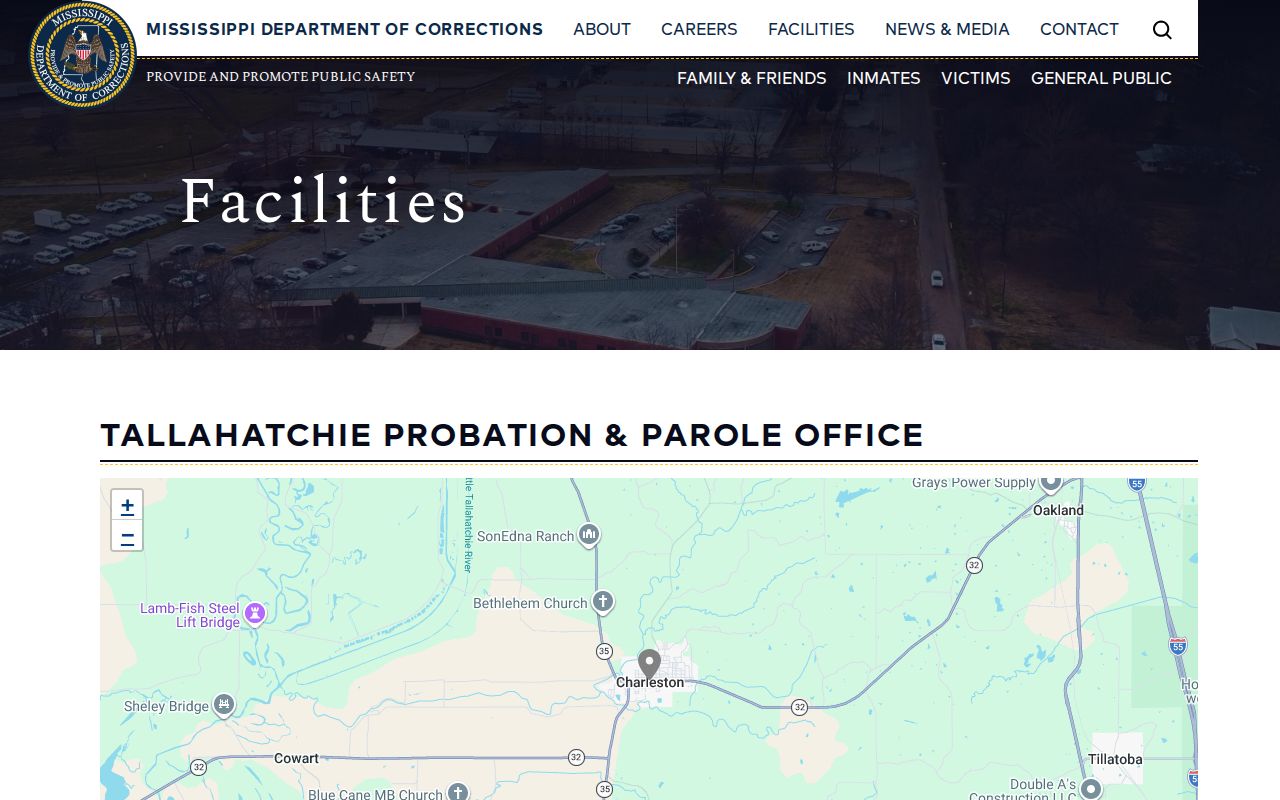
This local listing is useful for routing, but field-officer files may be exempt from disclosure under MDOC policy, so staff may provide only limited confirmation.
Tallahatchie Supervision Violations and Warrants
Conditions are the rules a supervised person must follow. They can involve reporting, travel approval, court obligations, or other terms set by the court, Board, or MDOC. A violation is an alleged breach of a condition. It does not by itself show that supervision was revoked. Revocation is a formal action that can return a person to custody after the required process.
An absconder is a person alleged to have stopped reporting or left supervision without permission. No official statewide public absconder or warrant list was located for Mississippi. A missing Tallahatchie County parole result cannot be labeled an absconder. Verify a warrant with MDOC or the proper law enforcement agency, and verify a court action through the court record. Mississippi SAVIN/VINE may issue alerts for return after absconding or other custody changes when the reporting agency participates, but an alert should be confirmed with the agency named in it.
- Parole
- Conditional release from prison under Board authority.
- Probation
- Court-ordered community supervision.
- Absconder
- A person alleged to have stopped complying with supervision contact.
- Revocation
- A formal action ending conditional release and potentially returning the person to custody.
- Discharge
- Completion of the sentence or supervision term.
Note: Confirm the exact status with the responsible office because public search gaps do not establish a violation, warrant, or discharge.
How Tallahatchie Supervision Ends
Supervision ends through an official discharge, sentence expiration, court action, or another documented change in status. An estimated date is not the same as completion. MDOC records use terms such as flat-time date, tentative release date, ERS, parole, and discharge for different events. The strongest proof is the final MDOC or court record showing the actual end of supervision.
A records request to MDOC can seek the nonexempt offender data sheet or time sheet, actual release or discharge date, release type, discharge certificate, and parole or ERS start and end dates. Telephone requests are not accepted for the formal MDOC public-record process. The GovQA route is available through the MDOC public-records page. Copies are listed at $0.15 per page, and added labor or delivery costs may apply. The policy describes a written response within seven working days, with ordinary production by 14 working days unless more time is needed.
For probation imposed in a Tallahatchie County Circuit Court case, use the Seventeenth Circuit MEC information to identify the filing district. Tallahatchie has court locations in Charleston and Sumner, so checking only one district can miss the relevant order.
The underlying county release event is a separate question. Tallahatchie County release records and search paths are covered on the released-inmate search home page. A county bond release does not establish MDOC supervision, and an MDOC discharge does not identify every earlier county booking.
Tallahatchie Parole Decision Verification
The Mississippi State Parole Board makes parole decisions, while MDOC manages day-to-day supervision. No official public name-searchable hearing calendar or decisions database was found. The Parolees Search is post-release evidence, not a Board decision archive. It cannot show every denial, deferral, rescission, grant awaiting execution, or condition attached to a decision.
For a specific case, contact the Mississippi State Parole Board at 601-576-3520 or MSStateParoleBoard@mdoc.state.ms.us and provide the MDOC number. A grant does not prove the person has left prison. Release planning, a detainer, required documents, or another custody authority can delay or redirect the event. Confirm the actual release through MDOC and then check the local office if Tallahatchie is the supervision county.
Parole eligibility is not a release promise. Miss. Code §47-7-3 and related provisions make eligibility depend on the crime, crime date, sentence, history, statutory exclusions, and time served. The 2021 Earned Parole Eligibility Act amended that framework. Hearing and notice rules, minimum-service rules, and Board records provisions may also apply. Because those rules turn on an individual judgment and offense history, a universal eligibility fraction would be misleading.
A decision record should be read by its exact date, disposition, and conditions. Then check whether MDOC executed the release. A detainer is an official request or hold from another authority, and it can prevent community release even after favorable Board action.
Tallahatchie Release Reentry Resources
MDOC’s statewide Reentry Resource Guide identifies North Mississippi Rural Legal Services as serving the northern 39 counties, with statewide intake at 800-498-1804. That resource can help route legal and reentry questions after a Tallahatchie County release. It is not a custody-status source, a parole search, or a promise that a particular service is available.
Program eligibility and intake can change. Confirm the service directly before relying on it. Supervision questions still belong with MDOC, the Charleston office, the sentencing court, or the Parole Board according to the issue.
Tallahatchie Release Documents and Funds
MDOC says institutional funds are made available after release instead of being handed out as cash, and funds follow a person who is transferred. That difference can help families distinguish a true MDOC release from a move to another institution. MDOC also describes pre-release access to identification and other documents through its reentry documentation resources.
Missing identification or a disputed record should be addressed with the source that holds it. Give the exact MDOC or booking number, the date, and the field believed to be wrong. A correction to one government record does not automatically change court, registry, or private copies.